
Johns Manville Attic Insulation in Sunrise Manor: A Homeowner’s Guide
Johns Manville has been making insulation since 1858 – but a century-plus track record doesn’t mean every product in their lineup belongs in a Sunrise Manor attic that’s regularly hitting 160°F in July. For most Sunrise Manor homes, JM’s blown-in fiberglass is the better fit; their batts make more sense in specific attic shapes we’ll get to. The choice comes down to attic geometry, what’s already up there, and how the material handles desert heat cycling over 15 years. If you’d rather skip the research and get a straight answer, call (888) 751-6515.
JM Blown-In Fiberglass vs. Batts: Which Wins in a Sunrise Manor Attic?
Blown-in fiberglass wins for the majority of Sunrise Manor attics. Batts win in one specific configuration: a clean, standard-spaced, empty attic with no ductwork crossing the joists. Here’s how they stack up under real desert conditions.
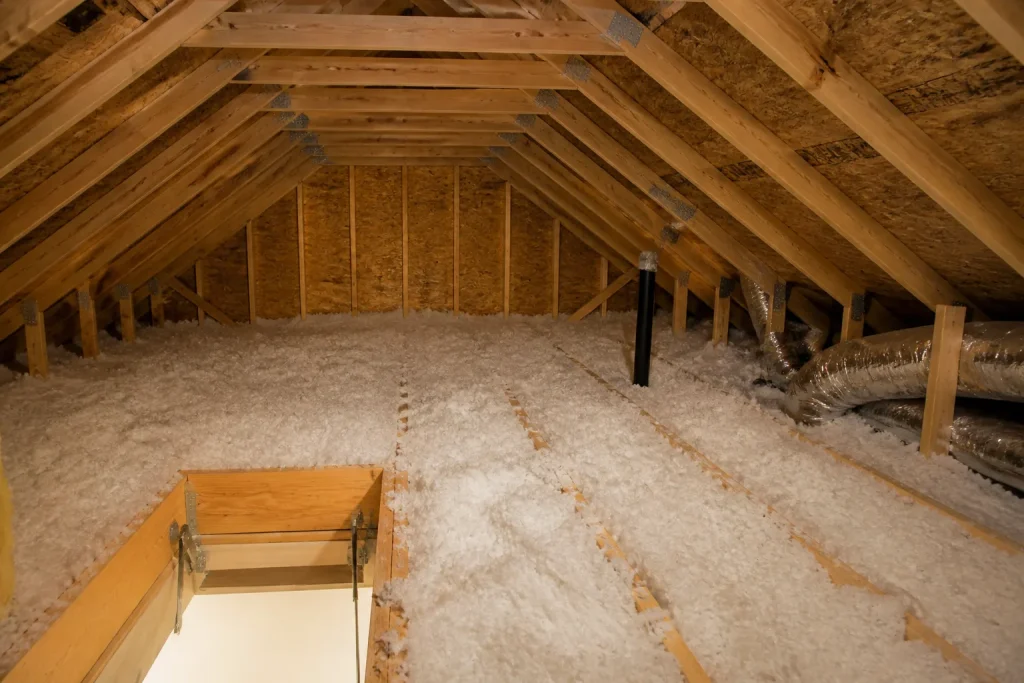
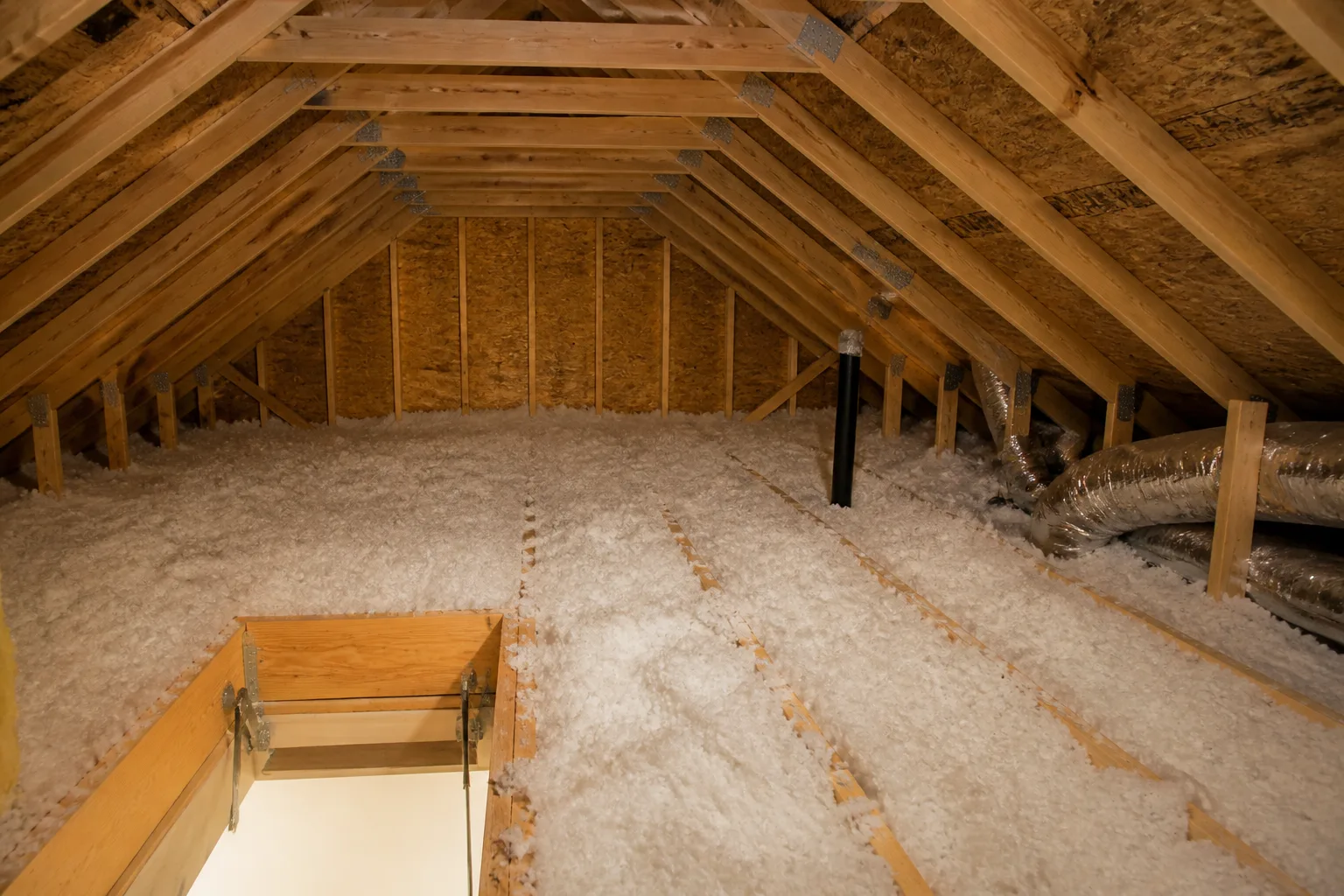
- Blown-in fiberglass (JM Spider or Climate Pro): Fills gaps, corners, and around pipes and ductwork. Covers irregular joist spacing. Best for older Sunrise Manor homes where the framing wasn’t built to a standard grid.
- Batts (JM ComfortTherm or R-Value Plus): Faster to install in new construction or perfectly framed attics. Cheaper on labor. But they leave gaps at the edges and around penetrations if they aren’t carefully cut and placed – and those gaps become hot spots.
- Heat cycling: Blown-in fiberglass doesn’t settle or compress as much through the daily 40-50°F swing between a 160°F July attic and a 70°F night. Batts, especially kraft-faced, can sag off the joists after a decade of that cycling if the installation wasn’t tight.
In our experience, the Sunrise Manor homes along North Pecos and up toward Frenchman Mountain – the ones with 1970s and 1980s framing – almost always do better with blown-in. The joist spacing is inconsistent and the ducts run crossways. Batts would need to be cut around every one of those obstacles, and every cut is a place where the R-value stops working.
Why R-Value Alone Is Misleading in a Vegas-Area Attic
R-value is measured at a standard 75°F mean temperature. Your Sunrise Manor attic isn’t operating at 75°F. At 150-160°F ambient, fiberglass performance drops, and the rated R-value on the bag is not what you’re actually getting in the peak of summer. This is the single biggest thing most contractors don’t tell Sunrise Manor homeowners.
What does that mean practically? A Johns Manville R-38 blown-in job that’s perfect for a North Las Vegas retrofit may underperform if it’s installed at the minimum depth for that rating. JM’s own coverage charts specify a minimum settled depth – often 13 to 14 inches for R-38 blown fiberglass – and the fiber needs to be installed at that depth, not eyeballed at “looks thick enough.”
Two things we check on every Sunrise Manor job that actually matter more than the headline R-value:
- Settled depth, not installed depth. Blown fiberglass settles 15-20% in the first year. JM’s chart already accounts for this – but only if the installer hits the spec.
- Air sealing before insulation. A perfectly rated R-38 with unsealed top plates and can lights is effectively an R-15 in terms of how it performs. JM’s material can’t compensate for air leakage it wasn’t designed to stop.
Vegas-area code for a Sunrise Manor attic is typically R-38 to R-49 depending on the build era and whether it’s new construction. But the code number is the floor, not the answer. If you’re curious how insulation and air sealing work together, our Attic Insulation in Sunrise Manor page walks through the whole sequence.
How Do You Verify a Contractors Installing JM to Spec?
Ask for three things before any Johns Manville insulation lands in your Sunrise Manor attic: a manufacturer coverage chart for the specific product, depth gauges visible in the attic during install, and photos of the finished depth reading. If a contractor can’t produce all three on request, they’re guessing.
Here’s what to look for:
- A current JM coverage chart. Johns Manville publishes these for every product line. The chart gives bags-per-square-foot by target R-value. Any contractor worth hiring has one on the truck.
- Depth markers installed before blowing. These are 12-to-14-inch cardboard rulers stapled to the joists every few bays. If your installer doesn’t set them, there’s no way to verify depth in the finished attic.
- Photos after the job. We send the customer a photo of a depth marker reading against a tape measure at completion. It’s ten seconds of work and it eliminates the whole question.
The alternative is a legitimate scam pattern we’ve walked into more than once: a truck sprays half the attic, tells the homeowner “that’s R-38,” and drives off. The homeowner has no way to check until the summer bill arrives. A true JM install has visible depth markers, a bag count that matches the square footage, and a written record of what was installed.
What Does Johns Manville’s Warranty Cover – and What Doesn’t It?
Johns Manville’s product warranty covers manufacturing defects in the material itself: a bad batch of fiberglass, delamination, or a defined defect in the batts. It does not cover installation problems. If the material is under-installed, poorly air-sealed around, or compressed by later ductwork, JM’s warranty won’t pay for the correction – even though the material itself never failed.
That’s why the installer’s workmanship guarantee matters more than the product warranty. In practical terms, for a Sunrise Manor homeowner:
- JM product warranty: Replaces defective material. Doesn’t cover labor. Doesn’t cover the homeowner’s heating and cooling bills from an underspec install.
- Your installer’s guarantee: This is what covers the installation – which is 90% of the variable in how well the material actually performs.
- The Done Right Promise: Our guarantee on every job – lifetime workmanship. If the installation isn’t done right, we come back and make it right. No runaround, no invoice, no debate about whether it’s a “manufacturing defect.”
When you’re comparing bids from different crews for a Sunrise Manor job, ask what their workmanship guarantee actually says. “One year on labor” is common. “Lifetime” is what you want.
The One Attic Configuration Where JM Blown-In Outperforms Everything Else
The configuration is this: a low-pitch Sunrise Manor attic with existing batts that have sagged, cross-braced rafters under 4-foot height, and HVAC flex duct running between the joists. In that scenario, JM blown-in fiberglass beats spray foam on cost and beats new batts on performance – and it’s not close.
Why? Spray foam would need to be applied to the roofline to work around the ducts, which is a much larger scope and cost. New batts would need to be cut around every joist bay and every duct, and they’d sag again through the same thermal cycling. Blown fiberglass fills around all those obstructions in a single pass. It also doesn’t stress the existing ceiling drywall by adding weight to the joists the way replacing batts does.
We pulled one out of a garage over near the Winchester area last summer that had the exact problem: sagged 1980s batts, flex duct work sitting on the joists, and a homeowner ready to spend foam money. We talked him out of it. Blown-in JM with air sealing dropped his August bill by more than a third, and the material fills all the gaps the old batts never did. That’s not a sales pitch – it’s the right call for that attic, and we’ll tell you when foam is the right call too. Our Spray Foam Insulation in Sunrise Manor page covers that side of the decision.
When to call a pro: if your attic is above 110°F, has vermiculite or other suspect material from an older Sunrise Manor build, or runs under 4 feet of clearance, get a professional in to look before you crawl up there yourself. Heat exhaustion in a Sunrise Manor attic in July is a real risk, and vermiculite from mid-century homes in this area can contain asbestos – a material you don’t want to disturb without a licensed removal pro.
Related services in Sunrise Manor: Crawl Space Encapsulation & Vapor Barrier in Sunrise Manor and Walt’s Insulation Sunrise Manor home.
Frequently Asked Questions
Yes – JM’s blown-in fiberglass is a solid choice for Sunrise Manor’s desert climate, provided it’s air-sealed underneath and installed at the correct settled depth. Their batts work too, but only in clean, standard-framed attics. The material is not the problem; the installation spec is.
Sunrise Manor attics typically need R-38 to R-49 depending on the build era. Older 1970s homes in the area often need to go to R-49 to compensate for air leakage that predates modern sealing standards. Call (888) 751-6515 for an exact recommendation – estimates are free.
Installed JM blown-in fiberglass for a typical 1,200 square-foot Sunrise Manor attic runs roughly $1,400 to $2,600 depending on existing insulation removal, air sealing, and target R-value. Batts in the same size run $1,800 to $3,200 installed. Call (888) 751-6515 for an upfront, line-item estimate.
Often yes, for standard blow-in jobs in a Sunrise Manor attic with no removal needed. Attics that need old insulation removed, rodent proofing, or air sealing typically run 2-3 days. Call (888) 751-6515 and we’ll give you a realistic timeline on the phone.
The Bottom Line
Johns Manville makes good material, and for most Sunrise Manor attics, their blown-in fiberglass is the right fit. The variables that actually determine whether it works in your home are settled depth, air sealing underneath it, and a contractor who will show you the coverage chart and the depth gauge photos rather than eyeball it. If a bid comes in suspiciously cheap, that difference is almost always the missing depth and the missing air seal.
If you’re in Sunrise Manor and want a straight answer on what your attic actually needs – batts, blown-in, or foam – Walt’s Insulation Sunrise Manor offers free estimates with upfront pricing, no trip charge inside our service county, a free second opinion on any written bid, and a permanent 10% discount for seniors and veterans. We install Johns Manville, Owens Corning, and GreenFiber, and we’ll tell you which one fits your attic instead of the one with the best margin. Call us at (888) 751-6515 – a live person answers, every time.
Written by the team at Walt’s Insulation Sunrise Manor.
Need Insulation Help?
Call Walt's Insulation Sunrise Manor - licensed & insured, here with fast after-hours help in Sunrise Manor.
(888) 751-6515