
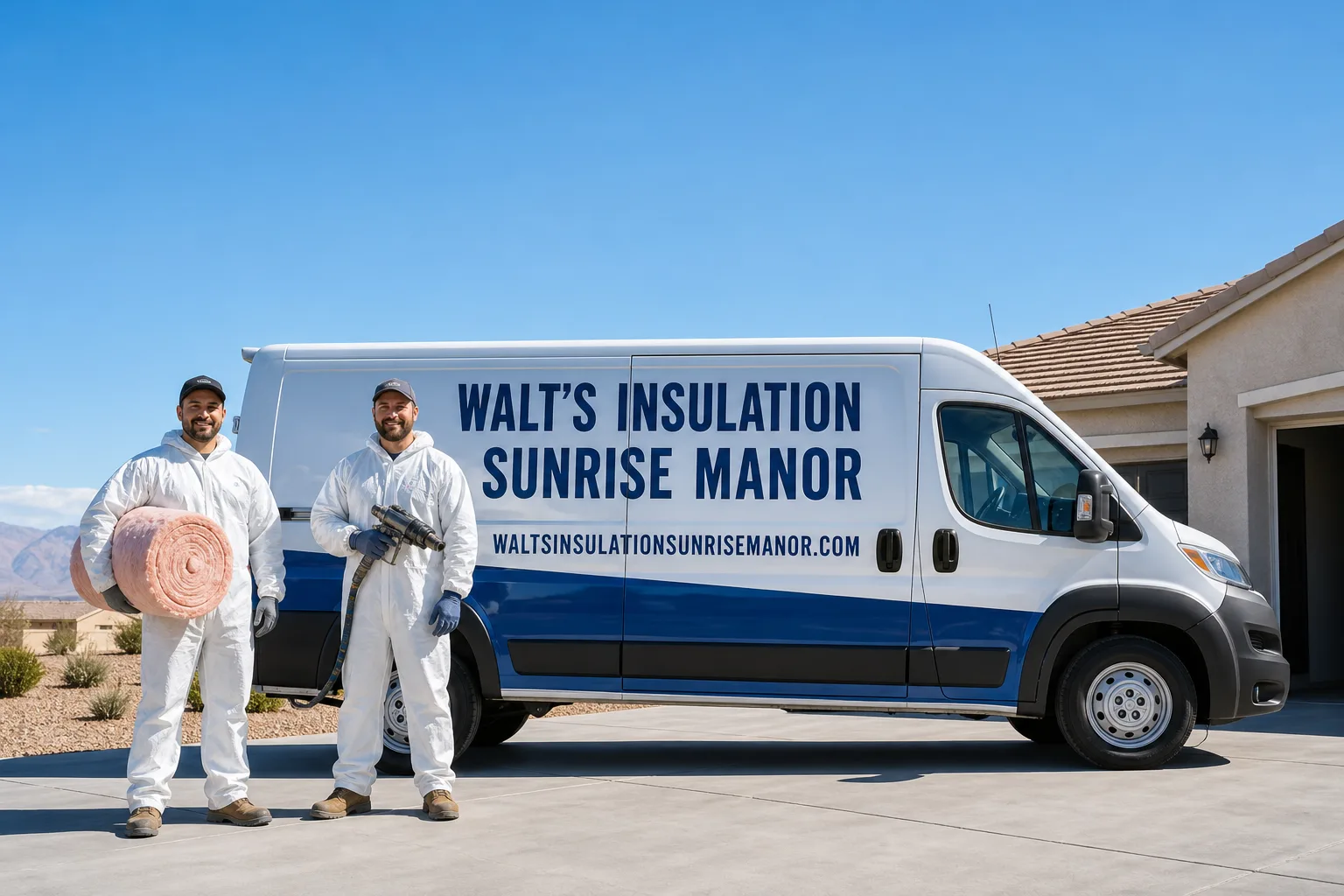
What Insulating a Whole House Costs in Sunrise Manor, NV
Insulating a full house in Sunrise Manor typically runs $2,400 to $5,800 for a 1,200-1,800 sq ft single-family home when you do the attic, the walls, and the duct-penetration air sealing together. That range is lower than most national cost guides suggest, and the reason is simple: nearly every home here is built on a slab, so there’s no crawl-space or floor insulation budget line at all. Call (888) 751-6515 and we’ll map your actual scope before you spend a dollar on a single line item.
Why a Slab Foundation Changes Your Whole-House Quote
If a contractor hands you a full-house insulation quote for a Sunrise Manor home and includes a crawl-space line item, hang up. Nearly every house here is slab-on-grade. That’s not a small clerical mistake. It tells you they’ve never walked a neighborhood like yours and are pasting in numbers from a northern-climate template where floors and basements carry real weight.
In a slab-on-grade house, the floor isn’t part of the thermal envelope in any way that matters. The heat doesn’t escape down through concrete, and the desert ground won’t chill your living room in January the way it matters up north. That leaves two places where your money should actually go: the attic and the wall cavities. A whole-house quote in Sunrise Manor is really an attic-and-wall quote, and you should insist a contractor say so out loud.
Here’s the practical version. For a 1,200 sq ft home built slab-on-grade in the 1970s, the attic is roughly 65-75% of the thermal loss you can realistically fix, the walls are another 20-25%, and the remaining sliver is air leaking through duct penetrations, the evaporative-cooler opening in the roof, and can lights. When you see a quote that allocates money somewhere else, that money is being misallocated.
Sunrise Manor Whole-House Cost Breakdown
Prices vary with attic square footage, how much old insulation has to come out, and whether your walls are open enough to blow into. These are the ranges we see on real Sunrise Manor jobs:
| Scope item | Typical range |
|---|---|
| Attic top-off to R-38/R-49 (blown fiberglass or cellulose) | $1,200 - $2,400 |
| Insulation removal, cleanup, and rodent proofing (when the old blanket is contaminated or crushed) | $800 - $1,800 |
| Wall cavity insulation for 1960s-1980s stucco frames (injection from exterior) | $1,100 - $2,600 |
| Duct-penetration air sealing and attic air sealing | $350 - $900 |
| Radiant barrier (optional, for west- and south-facing roof decks) | $900 - $2,200 |
| Full house: attic + walls + air sealing | $2,400 - $5,800 |
Attic-only is the phased approach most Sunrise Manor homeowners take first, and it’s the highest return for the money. Wall cavity work makes more sense when you’re already re-stuccoing, adding an addition, or the north-facing rooms are noticeably cold in January. We’ll tell you which line item earns its keep for your house, not just quote you the biggest number.
Where the Budget Actually Should Go, in Order
The attic is first because it’s the cheapest square footage to improve and it’s where the sun does the most damage. Sunrise Manor sits at roughly 1,800-2,000 feet on the northeast edge of the valley, and summer attic temps here blow past 150°F. Original builder-grade batts from the 1960s through the 1980s have spent decades getting compressed by HVAC techs and cable installers walking across them. Restoring that blanket to R-38 or R-49 is the biggest single cooling-bill move you can make.
Walls come second. A lot of the older stucco tract homes here still have R-11 in the walls, or nothing at all in some exterior cavities. We inject Owens Corning or GreenFiber loose fill through the exterior so we’re not tearing up your drywall. It’s slower work and it costs more per square foot than the attic, but the north rooms stop feeling like a different house in winter.
Air sealing is the line item everyone skips, and it’s the one that can quietly undo the other two. Canned lights, the HVAC plenum runs, and those aftermarket evaporative-cooler roof penetrations bleed cool air all summer long. Without sealing them, a fresh R-49 attic still leaks. We check for crushed insulation along plenum runs and around the swamp-cooler opening before we quote, because that’s where the job gets shortchanged.
Common Local Scenarios
Three patterns come up again and again on these streets:
- The 1972 stucco ranch near Desert Pines. Original R-11 batts in the attic, crushed to about R-6 under a foot of cable runs. Attic top-off plus removal runs about $2,200-$3,000, and the homeowner typically sees the biggest change in July and August.
- The 1960s-1980s tract home that’s been added onto. An addition means an uneven ceiling cavity and a wall that may or may not be insulated at all. We scope by zone, not by a flat per-square-foot number, so the addition gets what it needs and the original roof deck doesn’t get over-billed.
- The manufactured home in one of the older parks. Belly-wrap insulation under a mobile home has its own cost structure entirely, and a tract-home quote model doesn’t cover it. Irrigation moisture and rodent damage are the usual failure modes under here, and belly repair is more surgical than attic work.
Why the Quote Itself Matters
Walt’s Insulation has been locally owned and owner-operated since 2000, and we back every install with our Done Right Promise: if it isn’t done right, we make it right, no runaround. Every visit is a background-checked, uniformed technician who answers to a real address and a real license, not an 800 number. Our technicians carry up to 26 years of experience, and we install Owens Corning, Icynene, GreenFiber, and Demilec products.
Two standing offers make this easy to check: a free second opinion on any written estimate, and no trip charge anywhere inside Clark County. So when you’ve got a full-house quote in hand and something about that crawl-space line feels off, we’ll look at it for nothing. We also take $40 off any repair over $200, and seniors and veterans get 10% off, always. If you’re still comparing materials, our insulation installation in Sunrise Manor page covers the product side in more depth.
FAQs
A full-house job in Sunrise Manor runs about $2,400 to $5,800 for a typical 1,200-1,800 sq ft slab-on-grade home, depending on whether walls and air sealing are included. Attic-only typically costs $1,200-$2,400. Call (888) 751-6515 for an exact figure on your square footage.
An attic-only top-off is cheaper up front and usually delivers the largest cooling-bill reduction per dollar in a Sunrise Manor slab home. Full-house makes sense when your walls are under-insulated and you’re planning other exterior work anyway. We’ll tell you honestly which one earns its money for your house. Call (888) 751-6515 for a free second opinion on any quote you already have.
It shouldn’t. If a Sunrise Manor quote includes crawl-space work for a slab-on-grade home, that contractor is using a template that doesn’t match your house. Bring it to us and we’ll review it for free, no trip charge inside Clark County, so you know exactly what you’re being charged for.
No. We don’t charge a trip fee anywhere inside Clark County, and estimates are free. That includes driving out to review a competing written quote. Call (888) 751-6515 and we’ll set a time.
Ready to stop guessing at line items? Walt’s Insulation Sunrise Manor will scope your attic, walls, and air sealing against your actual house, not a template. Call (888) 751-6515 for a free estimate today. A real person answers, 24/7. Back to our home page if you’re still comparing services.
Written by the team at Walt’s Insulation Sunrise Manor, serving Sunrise Manor, NV.
What Our Customers Say
"Good honest work on the attic. The price was a little higher than one online quote, but Walt is the one who actually showed up, and that was worth it to us."
- Helen Tran"We had the walls of our old house filled with foam through small holes from the outside. Patched and painted the same afternoon. The bedrooms hold heat now and the furnace runs a lot less."
- Linda Baumgartner"The house had rats in the attic insulation and a smell we could not place. Walt's crew pulled all of it, sealed the gaps where they were getting in, sanitized, and put in new blown-in. He sent photos of the sealed openings so I could see it done."
- Rosa Delgado